water, plants, wildlife
Is it a bird? Is it a crane?
NOPE, IT’S A HERON. I get notifications for nearby movement on the security camera I’ve pointed at the pond. I originally only put the camera there to monitor how quickly the water levels were going down and assess if it was attributable to the heatwave or a fountain leak (I’ve now ascertained it’s almost certainly the former), but a happy side effect of this is waking up to the following images at 7AM on a Sunday morning.
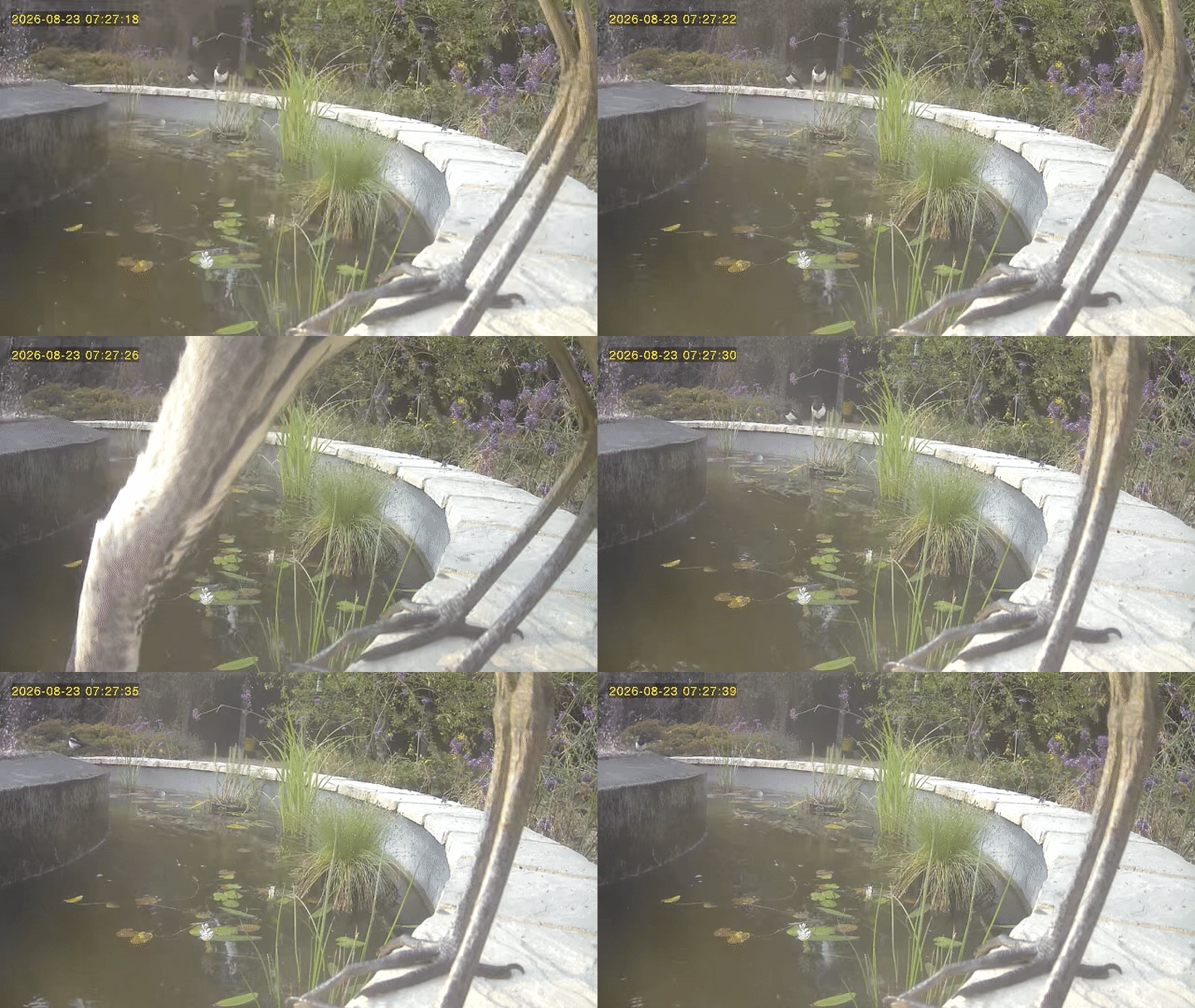
At first, I honestly thought someone was winding me up, playing a prank on my little pond hobby project by placing a set of dinosaur-leg cutouts in front of the camera. But when they bent slowly backwards and that lanceolate beak stooped down, the thrill I experienced, be still my beating heart!
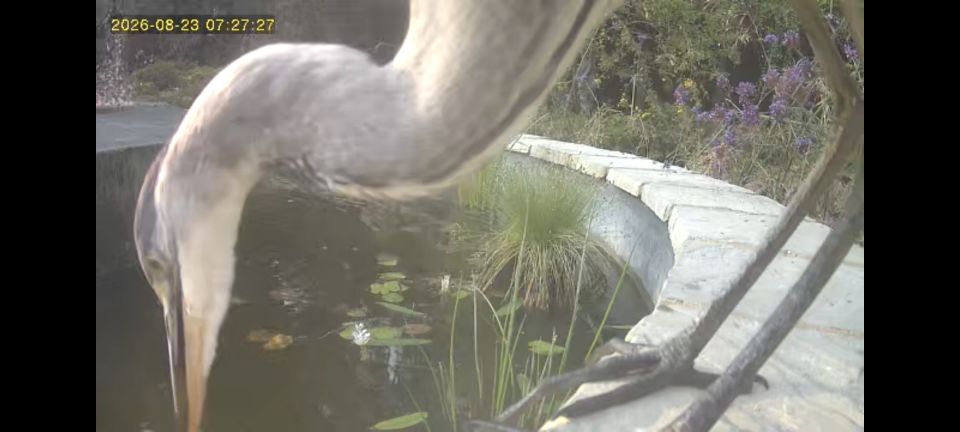
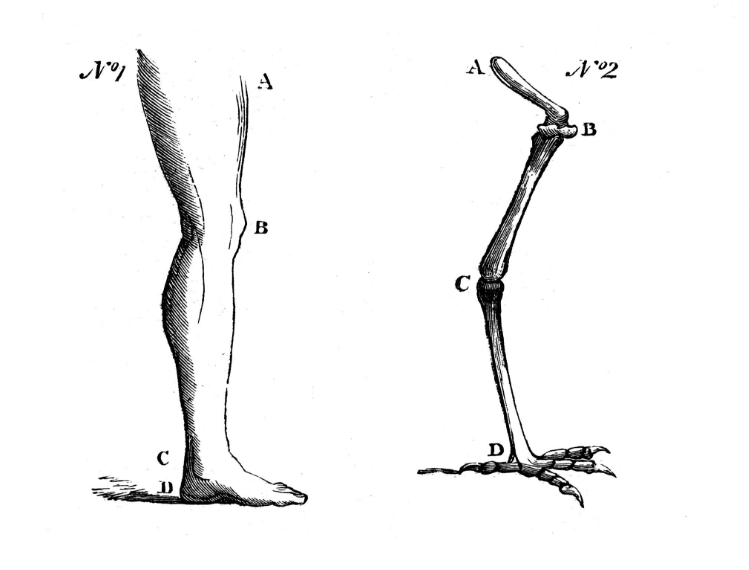
Herons are fascinating creatures. Despite their relative abundance in Britain, it always feels like a treat if you spot one in the wild, and that wild now apparently includes a pond fountain oasis right in the middle of central London. They have a wonderful prehistoric quality to them; it’s a shame that the camera didn’t catch the bird taking off like a giant pterodactyl, leaping with such confidence and swagger, as if they’re simply climbing into the sky by taking big swooping armfuls of air. Their legs look so alien but actually aren’t too different in structure to our own. Herons, and many other birds, have what are called digitigrade legs, meaning they walk on their digits. Humans have plantigrade legs; we walk on our feet. So what you’re actually seeing when a heron “bends its leg backwards” is it simply flexing its ankle, the same way that we do. Their similarly orientated knee joint is most commonly hidden behind a thick plumage of bird belly feathers, as shown in the (hopefully open-licensed) Victorian anatomy diagram here:
Apparently there’s a major heron colony (a heronry) in Regent’s Park, which isn’t too far away from here, about 3km as uhhhh the bird flies. Since the cleanup of London’s canals over the past 30 years or so, the numbers of wild herons have bounced back encouragingly, so it’s nice to see our fountain pond now forming a part of this interconnected, pan-city aquatic buffet for these “micro-megafauna”. Despite what I said previously about dragonflies, the herons are the key apex predator of this food chain. They have a remarkable ability to stand dead still for extended periods of time, waiting patiently in the shallows before their S-shaped neck, coiled tightly back in anticipation, springs forward and spears its prey with a razor-sharp beak.

A few other cool notes on the heron: They have a built-in dry-shampoo system. Because they don’t excrete oils to waterproof and subsequently keep themselves clean like other birds do, their feathers have evolved to slowly crumble at the tip into a fine, talcum-like powder that soaks up the detritus of fish slime and other aquatic muck. They also have a specialised pectinate claw on their middle toes that acts as a serrated comb-like appendage they use to scratch the feather powder through their plumage and keep themselves elegant and aerodynamic.
Of particular interest to me (whomst likes microscopes and optical physics etc etc) is the fact that they possess incredible patterns of behaviour capable of affording themselves refractive-adapted vision. They will aim to stare down a prey directly perpendicular to the water’s surface in order to avoid mislocating the position due to water refraction (the same kind you see when looking at the position of a straw in a glass of water from an oblique angle). They also have a neurological adaptation that calculates the disparity between the virtual image projected onto the surface of the water and the true location, so they will always strike slightly off the apparent location to adapt for this.
And finally, they also have astonishing bifoveal eyes, meaning that the biological structure of their retinas includes two highly dense areas of photoreceptors per eye, in contrast to a human’s one area per eye. This is partly because their eyes are positioned further apart (relatively) on their heads than ours, allowing the central fovea to act like a wide-angle lens sensor region whilst their temporal fovea acts as a telephoto lens looking straight down their beak, creating a highly precise cone of binocular overlap for striking prey whilst simultaneously sensing any oblique threats. When the heron locks on to its prey, it will rotate its head to bring the target into the overlapping field of both temporal foveae, providing extremely precise stereoscopic vision and depth perception. A great example of millions of years of biological hardware and software evolving in tandem to produce a finely adapted predatory machine.
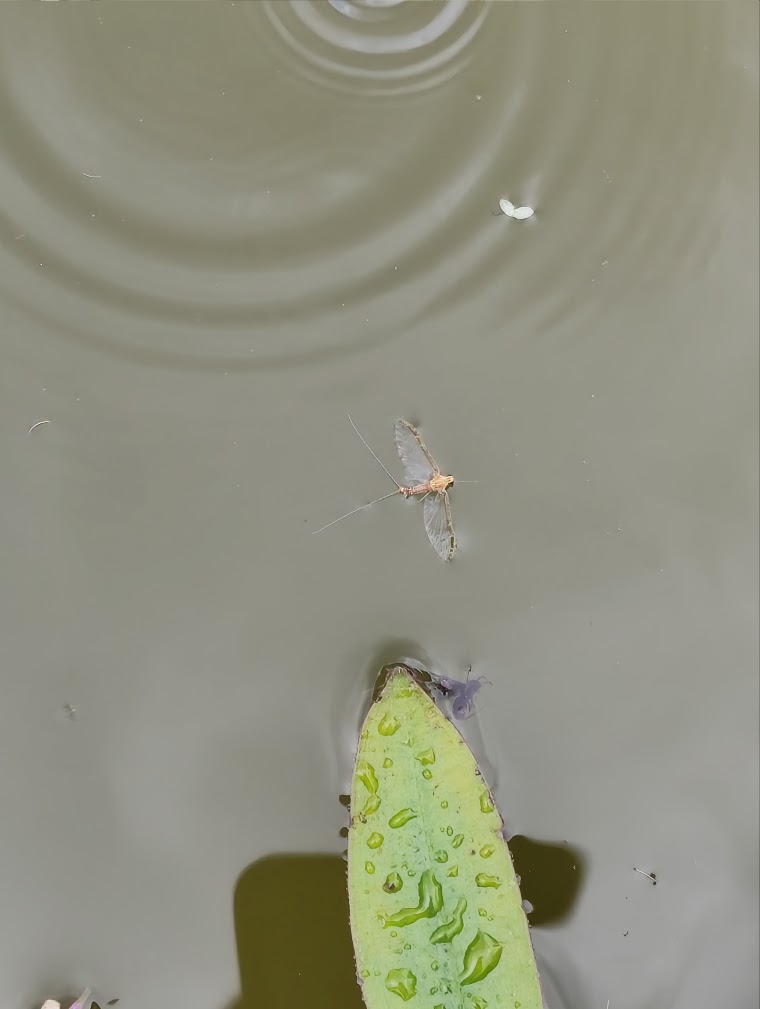
I completely didn’t expect to see one around the fountain pond, so I’m afraid the dragonflies have been shifted one down the uhhhhh pecking order. Speaking of which, I have also seen several adult mayflies around the pond, which are an excellent indicator of water quality. Strictly speaking, these mayflies were floating dead in the water, but for every spent one there will be many more living as a single adult can lay up to 10,000 eggs. The one pictured below is a spinner, or spent gnat, meaning it had completed its mating flight, deposited its eggs, and promptly expired on the surface of the water.
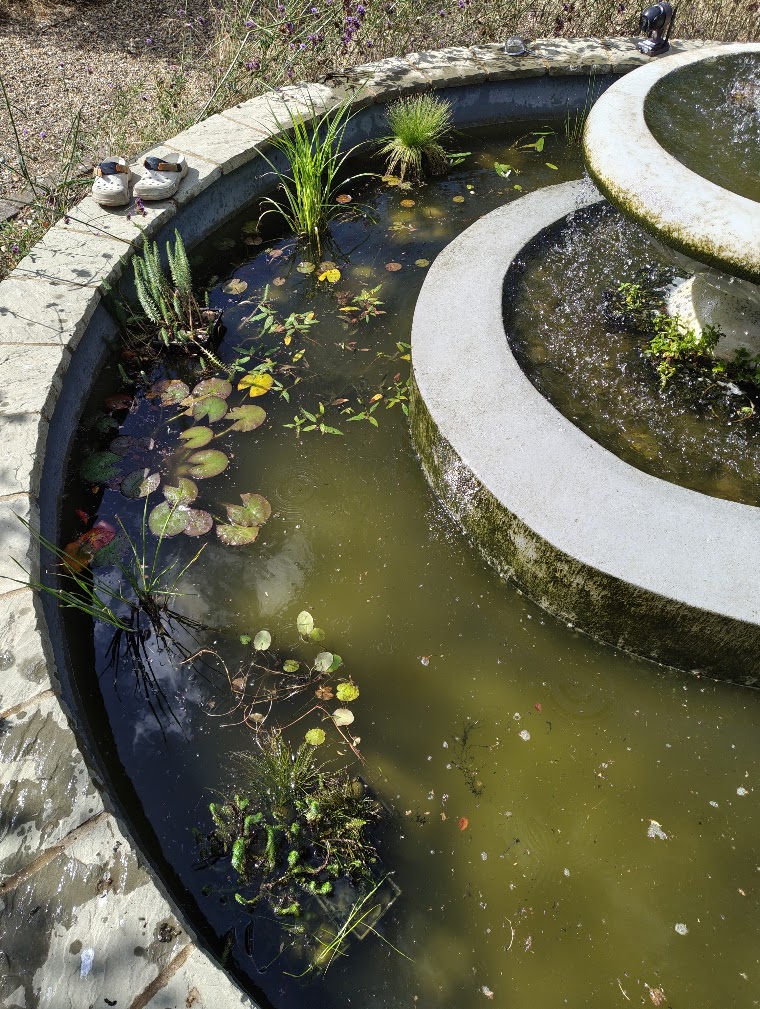
All the other plants are looking like they’re thriving, especially the water lilies (Nymphaea), floating heart (Nymphoides peltata), lesser pond sedge (Carex acutiformis), flowering rush (Butomus umbellatus), and the water hawthorn (Aponogeton distachyos). Here’s a photo of everything, including the water which is becoming clearer as the temperature subsides a bit post-heatwaves. The fountain is looking a bit algae-laden, so I think I will get in there and scrub it clean a bit before changing out some of that water when we can. I guess the higher algae content in the pond will make for great fertiliser if I exchange it for some fresh rainwater, so fingers crossed for that.
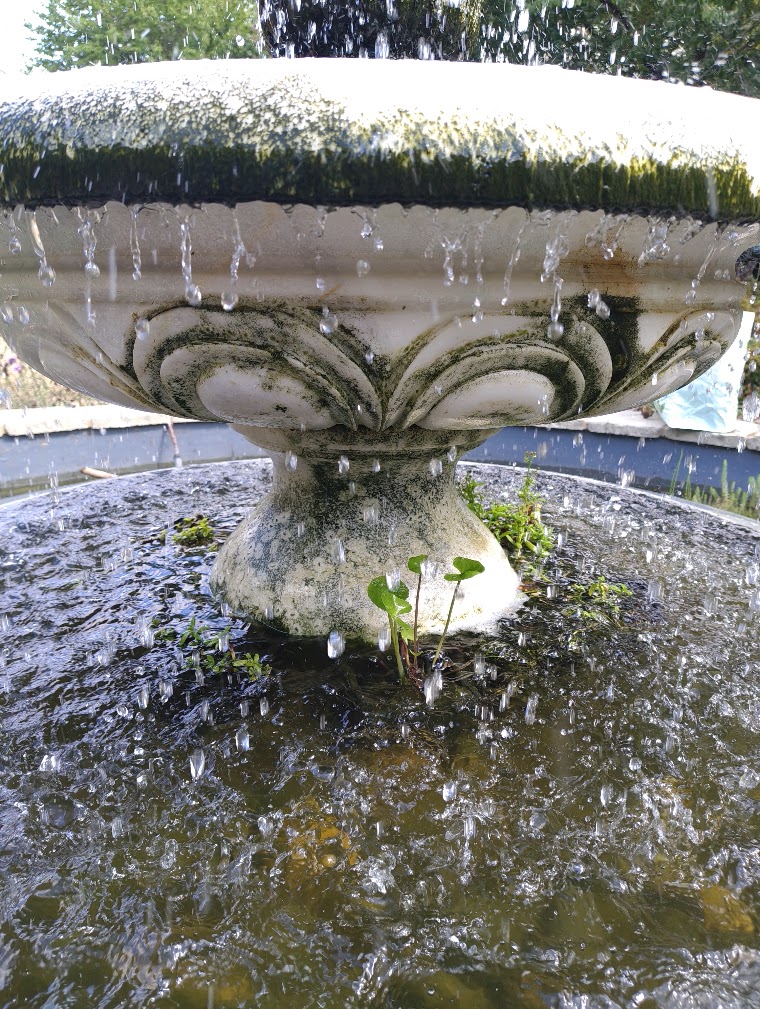
Focusing on the upper shelf, the marsh marigold (Caltha palustris) is thriving, and the water mint (Mentha aquatica), forget-me-nots (Myosotis scorpioides), creeping jenny (Lysimachia nummularia ‘Aurea’), and brooklime (Veronica beccabunga) are all going steady.
Here are the latest test results:
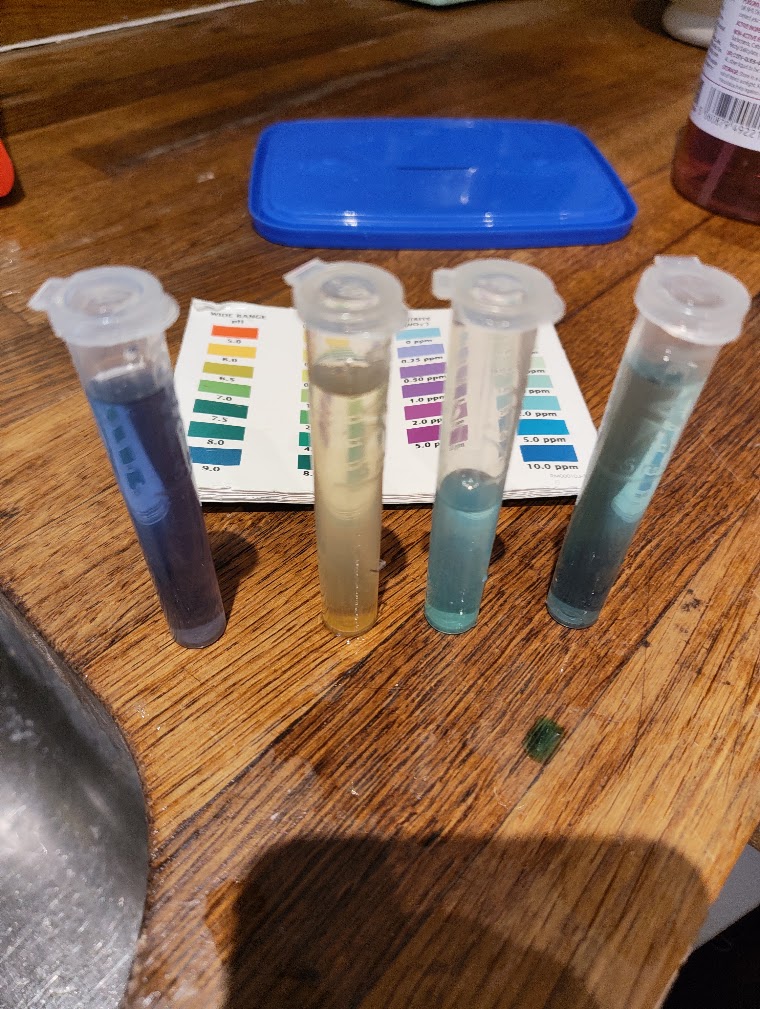
| 19 Jul | 25 Jul | 28 Jul | 06 Aug | 07 Aug | 16 Aug | 24 Aug | |
|---|---|---|---|---|---|---|---|
| pH | 9 | 9 | 9 | 7 | 8 | 9 | 9 |
| Ammonia | 0.25 ppm | 0 ppm | 0 ppm | 0 ppm | 0 ppm | 0 ppm | 0 ppm |
| Nitrite | 0 ppm | 0 ppm | 0 ppm | 0.5 ppm | 0 ppm | 0 ppm | 0 ppm |
| Phosphate | 1 ppm | 5 ppm | 1 ppm | 5 ppm | 5 ppm | 7.5 ppm | 5 ppm |
I think the next stage of the project, now that I’ve established the plants are viable in this fountain, is to give them space to grow. Over the next couple of weeks, I will begin to think about ordering larger baskets and more aquatic soil to give the plants the ability to really fill out the pond.